We now offer x-ray appointments at our Phenix, Charlotte, Rideau Valley, Nepean, Kanata, and Hunt Club clinics. Please check location availability before visiting.

Request an Appointment
Can you smoke before a CT scan? What patients need to know
TL;DR:
- Most clinics advise patients to avoid smoking for a variable period before a CT scan, with instructions depending on the exam type. Disclosing recent smoking to the clinic ensures accurate image interpretation and optimal results.
Most clinics ask you to avoid smoking for a few hours before a CT scan, with exact timing depending on the type of exam. The short answer: no, you should not smoke before your scan unless your clinic’s written prep sheet explicitly says otherwise.
Here is what to do right now:
- Check your prep sheet. Your clinic’s written instructions are the authority. Timing windows vary by CT type and facility.
- If you smoked within the restricted window, call the clinic before you arrive. Do not simply show up and say nothing.
- Tell the registration desk or technologist exactly when you last smoked and what you used (cigarettes, vaping, cannabis).
- Follow your clinic’s instructions first. The guidance in this article reflects common practice across Canadian facilities, but your specific prep sheet overrides general advice.
Canadian clinics, including those following Kingston HSC outpatient CT protocols and guidance from the NCBI patient preparation standards, routinely bundle smoking restrictions with fasting and caffeine rules to standardise your physiology before imaging.
Table of Contents
- Why smoking before a CT scan matters to your imaging team
- How long should you avoid smoking? Rules by CT type
- Vaping, nicotine gum, patches, and cannabis before a CT
- What to do if you smoked shortly before your appointment
- Medications, fasting, and arrival logistics tied to smoking rules
- Smoking and lung CT: what Canadian evidence shows
- Your pre-scan checklist for the day of your appointment
- Cdncare makes CT prep straightforward in Ottawa
- Key takeaways
- A clinician’s perspective on last-minute disclosures
- FAQ
Why smoking before a CT scan matters to your imaging team
Smoking affects your body in ways that show up directly in CT images, and the concerns differ depending on which part of your body is being scanned.
For chest CT and low-dose CT (LDCT) lung screening, recent smoking can alter lung density and trigger airway inflammation. This changes the appearance of lung tissue on the scan, which affects how a radiologist interprets the images. Peer-reviewed research published in Thoracic Imaging confirms a measurable “current smoker effect” on quantitative CT lung measures, meaning a radiologist who does not know you smoked recently may misread normal smoking-related changes as something more serious, or miss findings that are masked by inflammation.
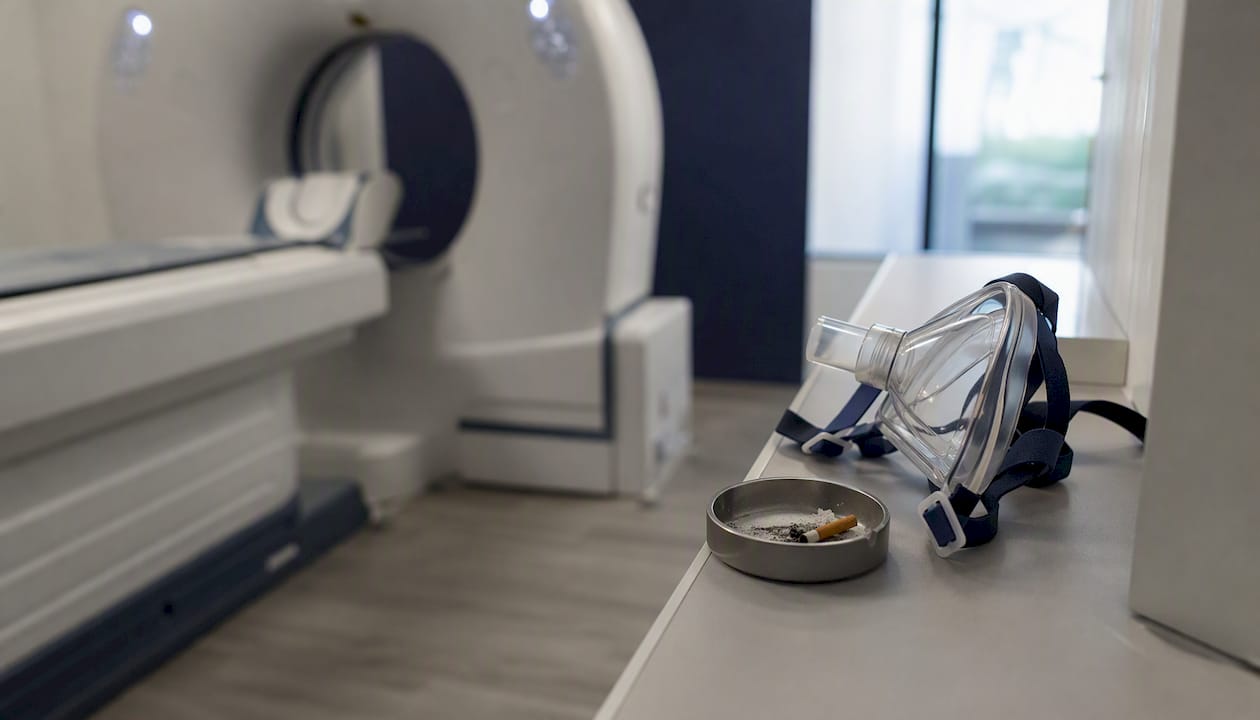
For coronary CT angiography (coronary CTA), the concern is your heart rate. Nicotine raises heart rate and can cause irregular beats. Coronary CTA requires a stable, often slow heart rate to capture sharp images of the coronary arteries. Even a single cigarette within a few hours of the scan can push your heart rate above the threshold where image quality suffers.
Coughing is a third factor. Smoking, especially recent smoking, can trigger coughing during the scan. Motion from coughing blurs CT images, which can mean repeating the scan or getting an inconclusive result.
Clinics bundle smoking restrictions with other rules (no caffeine for 12 hours, no alcohol for 12 hours) precisely because all of these factors affect the same thing: a stable, predictable physiological state that produces the clearest images.
How long should you avoid smoking? Rules by CT type
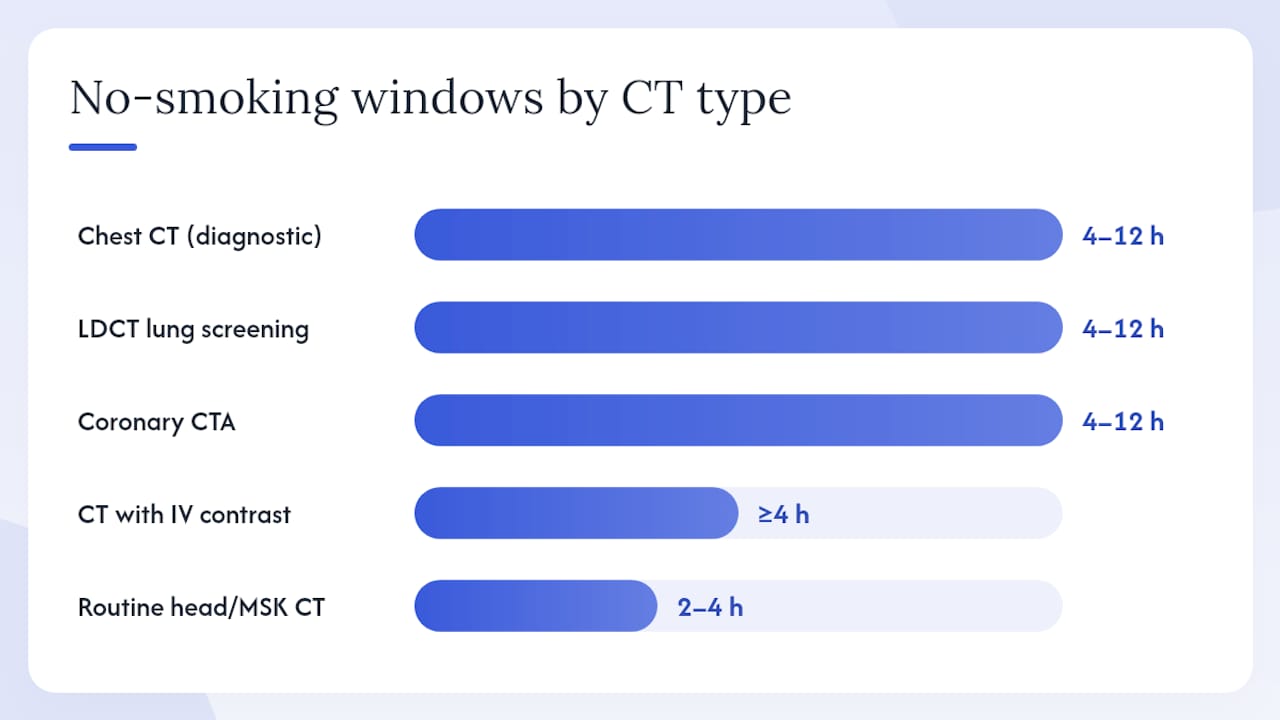
Timing windows vary by clinic and scan type. The table below reflects ranges commonly seen in Canadian and North American outpatient prep instructions. Always confirm with your own clinic’s written sheet.
| CT type | Typical no-smoking window | Primary reason |
|---|---|---|
| Chest CT (diagnostic) | 4–12 hours | Lung density, airway inflammation, coughing |
| LDCT lung screening | 4–12 hours | Densitometry accuracy, screening interpretation |
| Coronary CT angiography | 4–12 hours (often stricter) | Heart rate stability |
| CT with IV contrast (abdominal/pelvic) | 4 hours minimum | Fasting window, nausea risk, motion |
| Routine head or musculoskeletal CT | Varies; often 2–4 hours | Motion/coughing; less density-sensitive |
Some facilities specify up to 24 hours for certain exams. A patient preparation resource from NCBI Bookshelf notes that some pages recommend refraining from nicotine products for longer windows. Kingston HSC’s outpatient CT information lists a 12-hour window alongside caffeine and alcohol restrictions. For abdominal and pelvic CT, some clinics instruct patients not to eat, drink, or smoke for four hours before the exam.
The key point: coronary CTA tends to have the strictest rules because heart rate control is critical. A routine head CT is the least sensitive to recent smoking, though coughing is still a concern.
Vaping, nicotine gum, patches, and cannabis before a CT
Many patients assume that switching to a vape or nicotine gum the morning of their scan is a safe workaround. It usually is not.
Vaping and e-cigarettes deliver nicotine and produce airway irritation similar to combustible cigarettes. For coronary CTA, vaping raises heart rate just as smoking does. For chest CT, inhaled aerosol can trigger the same airway inflammation that affects lung density readings. Most clinics that restrict smoking also restrict vaping, even when the prep sheet does not list it explicitly.
Nicotine patches are generally better tolerated before a scan because they deliver nicotine slowly and do not involve inhalation. Some clinics allow patches during the restricted window. Check your prep sheet or call ahead.
Nicotine gum is a grey area. Chewing immediately before a scan can raise heart rate modestly and cause swallowing of air, which creates artefacts on abdominal CT. If your scan is for the chest or coronary arteries, avoid gum in the hours before your appointment.
Smoked cannabis carries the same concerns as tobacco: airway irritation, coughing, and altered lung appearance on chest CT. Inhaled cannabis is treated like smoking by most radiology teams. Oral cannabis products (edibles, oils) do not carry the same inhalation concerns, though they may interact with sedation or contrast protocols.
- Vaping: treat it the same as smoking for prep purposes
- Nicotine patches: usually acceptable; confirm with your clinic
- Nicotine gum: avoid in the hours before chest or coronary CTA
- Smoked cannabis: treat it the same as tobacco
- Oral cannabis: disclose it; ask your clinic about any interaction with contrast.
Pro Tip: When you book your scan, mention that you smoke or vape. The booking team can note it on your file and give you the specific prep instructions that apply to your exam type.
What to do if you smoked shortly before your appointment
This situation comes up more often than you might expect. The right move is always to disclose, not to say nothing and hope for the best.
Step 1: Call the clinic before you leave home. Tell them when you last smoked, what you used, and how much. They can advise whether to come in, arrive early for monitoring, or reschedule.
Step 2: If you are already at the clinic, tell the registration desk immediately. Do not wait until you are in the scan room. The technologist needs this information before positioning you.
Step 3: Describe the specifics. “I smoked one cigarette about 90 minutes ago” is far more useful than “I smoked this morning.” The team will factor in timing and product type when deciding how to proceed.
What happens next depends on the CT type. For a routine chest or abdominal CT, the technologist may proceed and note your smoking status for the radiologist. For coronary CTA, if your heart rate is elevated, the team may wait, administer medication to lower your rate, or reschedule. Rescheduling is uncommon for a single cigarette smoked several hours before, but it does happen when heart rate cannot be controlled.
Honesty protects you. A radiologist who does not know you smoked recently may interpret normal smoking-related changes as pathology, or miss findings masked by inflammation.
Medications, fasting, and arrival logistics tied to smoking rules
Smoking restrictions rarely stand alone. They are usually part of a broader prep package, and missing one item can affect the others.
Beta blockers and nitrates (coronary CTA): Many coronary CTA protocols require you to take a beta blocker before the scan to lower your heart rate. Smoking within a few hours of the scan works against this medication. If your prep sheet includes a beta blocker, the no-smoking window is especially important to follow.
Fasting: For CT with IV contrast (abdominal, pelvic, or vascular studies), fasting is typically required for 4 hours before the exam. Smoking during a fast can increase nausea and cause stomach cramping, which adds motion risk during scanning.
Hydration: Some contrast protocols ask you to drink water in the hours before the scan. Smoking can cause mild dehydration and may affect how contrast moves through your system.
What to bring and tell the clinic:
- Your written prep sheet (the clinic’s version, not a printout from a general website)
- A list of all current medications, including patches, inhalers, and supplements
- The time of your last cigarette or vaping session
- Any allergies, particularly to iodine or contrast agents
- Comfortable, metal-free clothing
Arrive at least 15 minutes early if you have any prep questions. The registration team can clarify instructions before you are called in.
Smoking and lung CT: what Canadian evidence shows
For patients undergoing lung cancer screening, the relationship between smoking and CT results is especially well documented.
The Canadian Task Force on Preventive Health Care recommends LDCT screening for adults aged 55–74 with at least a 30 pack-year smoking history who currently smoke or quit fewer than 15 years ago. Smoking cessation counselling is a standard component of these programmes. The Canadian Association of Radiologists (CAR) 2025 practice guideline reinforces that screening should occur only in expert healthcare settings and must include smoking cessation support.
What the research shows: A peer-reviewed study in Thoracic Imaging found that after adjustment, quantitative CT measures of emphysema were 3.5 percentage points lower and gas trapping measures 6.0 percentage points lower in current smokers compared with former smokers. This is the “current smoker effect” — active smoking masks emphysema on densitometry, which means radiologists must know your current smoking status to interpret results accurately.
Separately, research published in the European Respiratory Journal shows that smoking produces CT-visible changes even at relatively low pack-year exposure, including among workers with under 10 pack-years. This matters for differential diagnosis: a radiologist who does not know you smoke may attribute changes to another cause entirely.
Reporting your smoking status honestly does not make your scan less valid. It makes the radiologist’s interpretation more accurate. Lung screening visits are also increasingly used as an opportunity to connect patients with cessation support, which is a meaningful benefit beyond the imaging itself. For more on how lung health programmes integrate cessation resources, Garden State Medical Group’s lung health programme offers a useful overview of how screening and cessation work together.
Your pre-scan checklist for the day of your appointment
Print or screenshot this list and bring it with you.
- Avoid smoking (and vaping, smoked cannabis) for the number of hours your clinic specifies
- Bring your clinic’s written prep sheet
- Bring a complete list of your medications, including patches and inhalers
- Follow fasting instructions exactly (typically 4 hours for contrast CT)
- Drink water as directed; do not fast from fluids unless told to
- Wear comfortable clothing without metal zippers or underwire
- Remove metal jewellery before leaving home
- Note the exact time of your last cigarette or vaping session
- Call the clinic if you smoked within the restricted window before leaving home
- Have ready: time of last cigarette, product used, and your list of medications
Cdncare makes CT prep straightforward in Ottawa
Patients in Ottawa and eastern Ontario preparing for a CT scan can access clear, written prep instructions through Cdncare’s patient portal before their appointment. Cdncare operates across more than 20 clinic locations, with over 150 radiologists and technologists on staff who are accustomed to fielding last-minute prep questions, including those about smoking.
If you smoked recently and are unsure whether to proceed with your appointment, the team at Cdncare’s urgent care imaging clinic can advise you quickly. When you book, mention your smoking status so the team can attach the right prep sheet to your file and flag any scan-specific instructions. Results are typically available within 24–48 hours. Book your appointment or access your prep instructions at cdncare.ca.
Key takeaways
Most clinics ask patients to avoid smoking for a variable number of hours before a CT scan, depending on the type of exam; always follow your clinic’s written prep sheet and disclose your smoking status to the radiology team.
| Point | Details |
|---|---|
| Standard no-smoking window | Most clinics require 2–12 hours; some specify up to 24 hours for certain exams. |
| CT type determines the rule | Coronary CTA has the strictest requirements; heart rate stability is the main concern. |
| Vaping counts as smoking | Treat e-cigarettes and smoked cannabis the same as tobacco for prep purposes. |
| Disclose if you smoked | Tell the clinic before you arrive; the radiologist needs accurate smoking history to interpret results correctly. |
| Cdncare prep support | Cdncare provides written prep sheets and same-day guidance across Ottawa-area clinics. |
A clinician’s perspective on last-minute disclosures
Patients who smoked the morning of their scan and said nothing are not unusual. What is more unusual is the outcome when they do disclose: in most cases, the technologist simply notes the timing, checks heart rate if it is a coronary CTA, and proceeds. A single cigarette smoked three hours before a routine chest CT rarely changes the plan.
What does change the plan is finding out mid-scan that a patient smoked 20 minutes ago and has a heart rate of 95 beats per minute. At that point, the team has fewer options. Disclosing before you arrive gives the clinic time to adjust, whether that means a short wait, a medication to lower heart rate, or a reschedule that saves everyone time.
The single most practical thing a technologist can tell you: write down the time of your last cigarette before you leave home. That one detail answers the question the team will ask first.
FAQ
Can you smoke before a CT scan?
Most clinics ask you to avoid smoking for 2–12 hours before a CT scan, depending on the type of exam. Always follow your clinic’s written prep sheet, as the exact window varies by facility and scan type.
What can interfere with a CT scan result?
Recent smoking, caffeine, alcohol, motion from coughing, and an elevated heart rate can all affect image quality or interpretation. For chest CT, smoking alters lung density in ways that change how a radiologist reads the scan.
Can a CT scan detect that you are a smoker?
Yes. CT scans can show smoking-related changes in the lungs, including altered density and early emphysema, even at relatively low pack-year exposures. Radiologists use your reported smoking history to interpret these findings accurately.
When should smokers start CT lung screening in Canada?
The Canadian Task Force recommends LDCT lung screening for adults aged 55–74 with at least a 30 pack-year smoking history who currently smoke or quit fewer than 15 years ago. Speak with your physician about eligibility.
Is there anything else to avoid before a CT scan?
Common restrictions alongside no smoking include: no caffeine for 12 hours, no alcohol for 12 hours, fasting for 4 hours before contrast CT, and avoiding metal jewellery. Your clinic’s prep sheet will list everything specific to your exam.
Recommended
Your examination or doctor’s visit is 4 easy steps away