We now offer x-ray appointments at our Phenix, Charlotte, Rideau Valley, Nepean, Kanata, and Hunt Club clinics. Please check location availability before visiting.

Request an Appointment
DEXA scan explained: what it measures and why it matters
What is a DEXA scan and why is it done?
A DEXA scan, short for dual-energy X-ray absorptiometry, is a low-dose imaging test that measures bone mineral density at your spine and hips. It is the gold standard for diagnosing osteoporosis and estimating your risk of fracture. The test is painless, non-invasive, and takes a fraction of the radiation exposure of a standard chest X-ray.
Most patients come in after a doctor notices a risk factor during a routine visit, such as a family history of osteoporosis, a recent fracture from a minor fall, or long-term use of corticosteroids. The scan gives your care team a concrete number to work with rather than a clinical guess.
Here is what a DEXA scan measures and assesses:
- Bone mineral density (BMD) at the lumbar spine and hips, the two sites most predictive of fracture risk
- Body composition, including the ratio of fat mass to lean muscle mass, as a secondary application
- Baseline bone health for patients starting or already on osteoporosis treatment, to track changes over time
- Fracture risk, which your physician interprets alongside your age, sex, and medical history
What happens during a DEXA scan?
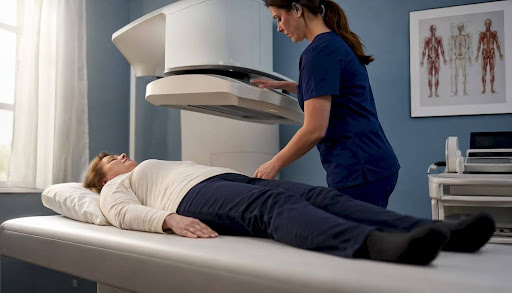
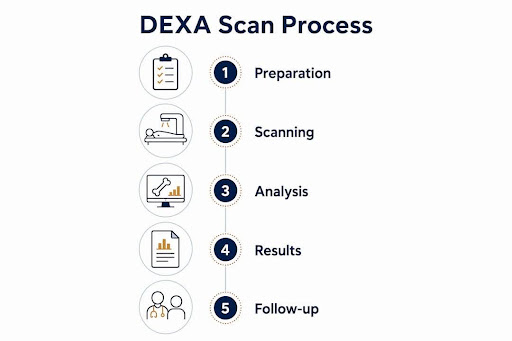
The scan procedure is straightforward and typically takes 10 to 30 minutes. You lie fully clothed on a padded table while a mechanical arm passes slowly over your lower spine and hips. You do not go inside a tunnel or enclosed space, which many patients find reassuring compared to an MRI.
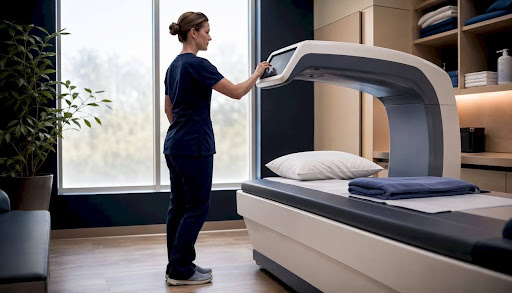
A technologist positions your legs using a foam cushion or foot brace to keep your pelvis flat and your spine aligned. Staying still is the main thing asked of you. Most people find the positioning comfortable, though patients with existing back or hip pain may need a moment to settle into place. Metal-free clothing is required, as zippers, underwire, or belt buckles can create image artefacts that affect the reading.
Before your appointment, keep these preparation points in mind:
- Avoid calcium supplements for at least two hours before the scan, as calcium can interfere with bone mineral measurements
- Wear comfortable clothing without metal fasteners, buttons, or zippers
- Bring your provincial health card and any relevant medical history or prior imaging reports
- Tell the clinic if you have had a barium X-ray, nuclear medicine scan, or contrast injection recently, as these can affect DEXA accuracy
The radiation dose is roughly one-tenth of a chest X-ray, comparable to the natural background radiation you absorb on a short flight from Toronto to Vancouver. For patients concerned about cumulative exposure, that context tends to put things in perspective. You can read more about safe radiation levels across common imaging tests.
Pro Tip: If you have had any imaging involving contrast or radioactive tracers in the past few days, let the clinic know when you book. Scheduling your DEXA too soon after those tests can produce inaccurate readings, and rescheduling is far easier than repeating the scan.
How do you read DEXA scan results?
Your results come as a T-score, which compares your bone density to the average peak bone density of a healthy young adult. The lower the score, the greater the degree of bone loss and the higher the fracture risk.
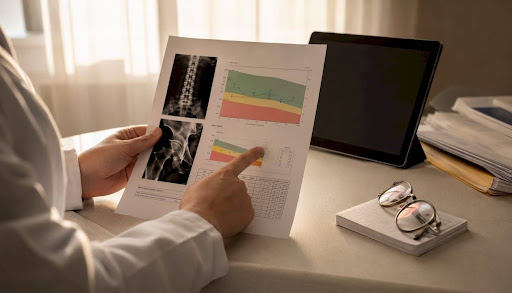
Here is how T-scores are categorised:
| T-score range | Classification | What it means |
|---|---|---|
| Above -1.0 | Normal | Bone density is within the healthy range |
| -1.0 to -2.5 | Low bone mass (osteopenia) | Some bone loss; monitoring and lifestyle changes recommended |
| -2.5 or lower | Osteoporosis | Significant bone loss; treatment discussion warranted |
| -2.5 or lower with a fracture | Severe osteoporosis | Highest fracture risk; active treatment typically indicated |
A T-score alone does not tell the whole story. Clinicians in Canada often use supplementary tools such as FRAX (the Fracture Risk Assessment Tool) or CAROC (the Canadian Association of Radiologists and Osteoporosis Canada tool) to calculate your ten-year probability of a major fracture. These tools factor in your age, sex, weight, smoking history, and other variables that a bone density number cannot capture on its own.
Your DEXA result is one piece of a broader clinical picture. A person with a T-score of -2.3 and no other risk factors may not need medication, while someone with a T-score of -2.0 and a recent wrist fracture likely does. The fracture risk assessment tools help clinicians make that distinction clearly.
Who should get a DEXA scan, according to clinical guidelines?
Not everyone needs a DEXA scan, and Choosing Wisely Canada specifically advises against routine testing in low-risk individuals. The goal is to focus the test on patients where the results will actually change their care.
Your physician will typically refer you for a DEXA scan if one or more of the following applies:
- You are an older adult, typically above the usual age thresholds for increased risk
- You are middle-aged with one or more clinical risk factors, such as a family history of fractures
- You have had a fragility fracture (a break from a fall at standing height or less) after age 40
- You are taking medications known to reduce bone density, including corticosteroids, aromatase inhibitors, or androgen deprivation therapy
- You have a condition associated with bone loss, such as rheumatoid arthritis, celiac disease, or hyperparathyroidism
- You are already on osteoporosis treatment and your physician wants to monitor your response
Choosing Wisely Canada's position is clear: indiscriminate testing exposes patients to unnecessary radiation and diverts resources from those who genuinely benefit. A tailored clinical assessment, not a blanket screening policy, is the right starting point.
How does a DEXA scan differ from other bone imaging tests?
The most common point of confusion is the difference between a DEXA scan and a bone scan. They sound similar but serve entirely different purposes.
A DEXA scan measures bone mineral content quantitatively, producing a density number that can be tracked over time. A nuclear bone scan, by contrast, uses a radioactive tracer to highlight areas of increased metabolic activity, which helps detect stress fractures, bone infections, or cancer spread. The two tests answer different clinical questions.
Here is a quick comparison:
- DEXA scan: Measures bone density at spine and hips; very low radiation; results in a T-score; used for osteoporosis diagnosis and monitoring
- Nuclear bone scan: Detects metabolic changes and injury patterns; higher radiation and tracer injection required; qualitative imaging; used for cancer staging, infection, or stress fractures
- Standard X-ray: Can show fractures and severe bone loss but misses early-stage density changes; not sensitive enough for osteoporosis screening
- CT scan: Provides detailed structural images but delivers significantly more radiation than DEXA; not the standard tool for bone density assessment
DEXA is considered the gold standard for osteoporosis diagnosis because it is accurate, reproducible, and uses minimal radiation. If you are wondering whether a bone density test can also detect arthritis, that is a separate question worth exploring, since DEXA and arthritis imaging serve different diagnostic goals.
Getting a DEXA scan in Canada: what to expect at Cdncare
Cdncare, operating as Canadian Diagnostic Network, is one of Ottawa's largest diagnostic imaging providers, with over 20 clinic locations and a team of more than 150 radiologists and technologists. DEXA scans are part of a broader range of services that includes ultrasound, X-ray, and mammography.
Here is what the process typically looks like when you book through Cdncare:
- Referral: Most DEXA scans in Ontario require a physician's referral. Bring your referral form and provincial health card to your appointment.
- Scheduling: Appointments are available across multiple Ottawa locations. Call or book online to find a time that works for you.
- At the clinic: Arrive in comfortable, metal-free clothing. The technologist will walk you through the positioning before the scan begins.
- Results: Reports are typically returned to your referring physician within 24 to 48 hours, supporting faster follow-up conversations.
- Cost and coverage: DEXA scans for osteoporosis screening are covered by OHIP when ordered by a physician for an eligible indication. Scans ordered for body composition analysis outside a clinical indication may not be covered; confirm with your clinic when booking.
Cdncare also collaborates with hospitals and healthcare partners, including through the Ontario Breast Screening Program, to provide integrated diagnostic support across the region. Clinics are scent-free environments, and staff are trained to accommodate patients with mobility limitations or positioning discomfort.
If you are ready to book or want to learn more about what the test involves, the bone density scan page at Cdncare has full details on locations, preparation, and what to bring.
Key takeaways
A DEXA scan is the most reliable, lowest-radiation method available for measuring bone density and guiding osteoporosis treatment decisions in Canada.
| Point | Details |
|---|---|
| Gold standard for bone density | DEXA is the clinically accepted test for diagnosing osteoporosis and estimating fracture risk. |
| T-score guides treatment | A T-score at or below -2.5 indicates osteoporosis; scores between -1.0 and -2.5 signal low bone mass. |
| Minimal radiation exposure | The dose is roughly one-tenth of a chest X-ray, similar to a short domestic flight. |
| Preparation matters | Avoid calcium supplements for at least two hours before the scan and wear metal-free clothing. |
| Not for everyone | Choosing Wisely Canada advises against routine testing in low-risk individuals; a physician referral ensures appropriate use. |
FAQ
What will a DEXA scan tell you?
A DEXA scan tells you your bone mineral density at the spine and hips, expressed as a T-score that indicates whether your bone density is normal, low (osteopenia), or in the osteoporosis range. Your physician uses this result alongside fracture risk tools like FRAX or CAROC to guide treatment decisions.
How long does a full DEXA scan take?
The scan typically takes between 10 and 30 minutes, depending on the sites being imaged. You spend most of that time lying still on a padded table while the scanner arm moves over your lower back and hips.
What is a normal DEXA scan score?
A T-score above -1.0 is considered normal. Scores between -1.0 and -2.5 indicate low bone mass (osteopenia), and a score of -2.5 or lower meets the clinical threshold for osteoporosis.
What is the difference between a bone scan and a DEXA scan?
A DEXA scan measures bone mineral density quantitatively and is used to diagnose osteoporosis. A nuclear bone scan uses a radioactive tracer to detect areas of abnormal bone metabolism, such as stress fractures, infection, or cancer spread; the two tests answer entirely different clinical questions.
Recommended
- What Happens During a Bone Density Scan?
- Precision Body Analysis
- Bone Density Scan | Canadian Diagnostic Network
- Can an Ultrasound Detect Breast Cancer?
Your examination or doctor’s visit is 4 easy steps away