We now offer x-ray appointments at our Phenix, Charlotte, Rideau Valley, Nepean, Kanata, and Hunt Club clinics. Please check location availability before visiting.

Request an Appointment
DXA scanning explained: what it measures and why it matters
TL;DR:
- DXA scanning accurately measures bone mineral density and body composition, primarily for osteoporosis diagnosis. It is safe, quick, and employs low-dose X-rays to detect early bone loss that may lead to fractures. Results help guide treatment, monitoring, and risk assessment in clinical practice.
DXA scanning, short for dual-energy X-ray absorptiometry, is the gold standard test for measuring bone mineral density. It scans your hip and spine using two low-energy X-ray beams, and it can detect as little as 2% bone loss per year. That level of sensitivity is what makes it so useful for catching osteoporosis early, before a fracture happens.
Beyond bone health, DXA also measures body composition, including fat mass and lean muscle mass, making it a tool used in both clinical and sports medicine settings. Your results come as a T-score, which compares your bone density to that of a healthy young adult. A T-score above -1 is normal, -1 to -2.5 indicates osteopenia, and below -2.5 confirms osteoporosis.
- Primary uses: diagnosing osteopenia and osteoporosis, assessing fracture risk, monitoring treatment response, and measuring body fat and muscle mass
- Sites measured: hip and lumbar spine (the most clinically reliable locations)
- Result format: T-score and Z-score, interpreted by a radiologist
When should you get a DXA scan?
Osteoporosis Canada recommends routine DXA screening for all women and men aged 65 and older. For younger patients, a scan is warranted when certain risk factors are present.
Your doctor may refer you earlier if you have:
- A history of low-trauma fractures (breaking a bone from a minor fall)
- Long-term use of corticosteroids such as prednisone
- Conditions like rheumatoid arthritis, celiac disease, or early menopause
- A family history of osteoporosis or hip fracture
Not every patient needs a scan. HealthLink BC notes that DXA is most appropriate when the results will actually change your care plan. For low-risk patients, lifestyle measures like weight-bearing exercise, calcium, and vitamin D often take priority over scanning.
Pro Tip: Before your appointment, write down any medications you take regularly, including supplements. Your referring physician needs this information to assess your risk accurately and decide whether a scan is the right next step.
How a DXA scan is performed
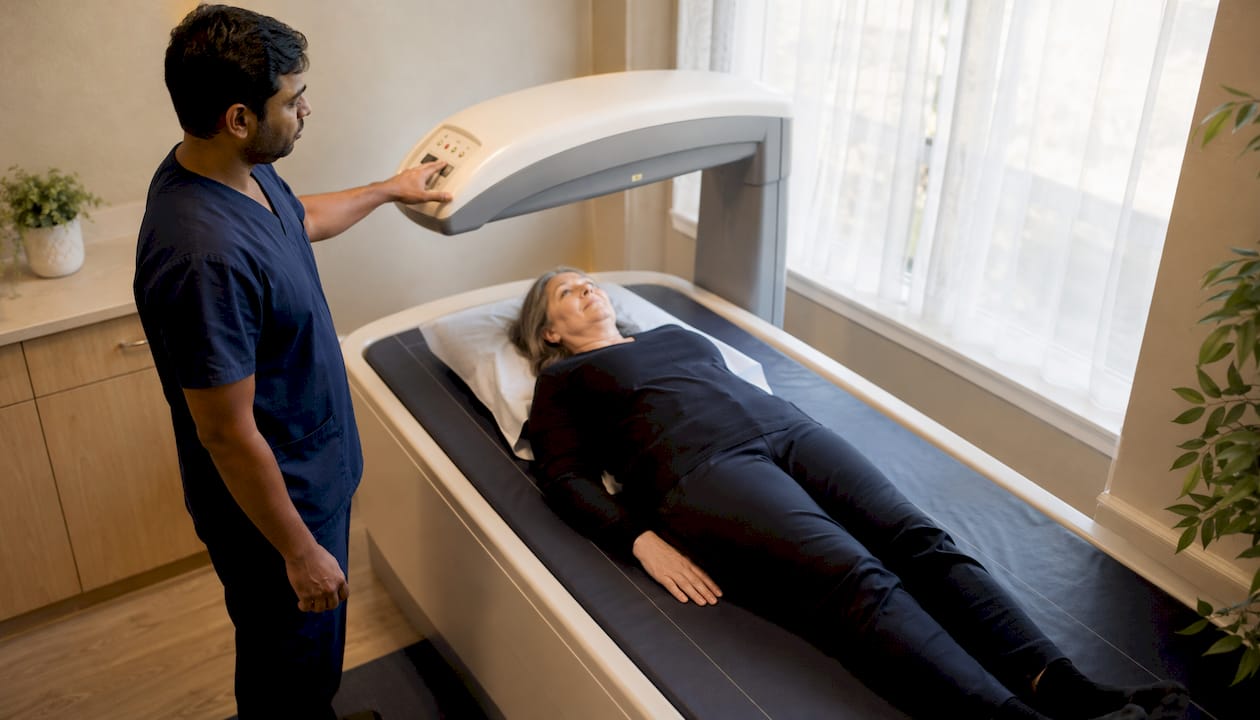
The procedure is straightforward and takes 15–20 minutes from start to finish. You lie fully clothed on a padded table while a scanning arm passes slowly over your body. There is no tunnel, no noise, and no discomfort.
Here is what to expect during the appointment:
- You remain still while the scanner moves over your hip and lower spine
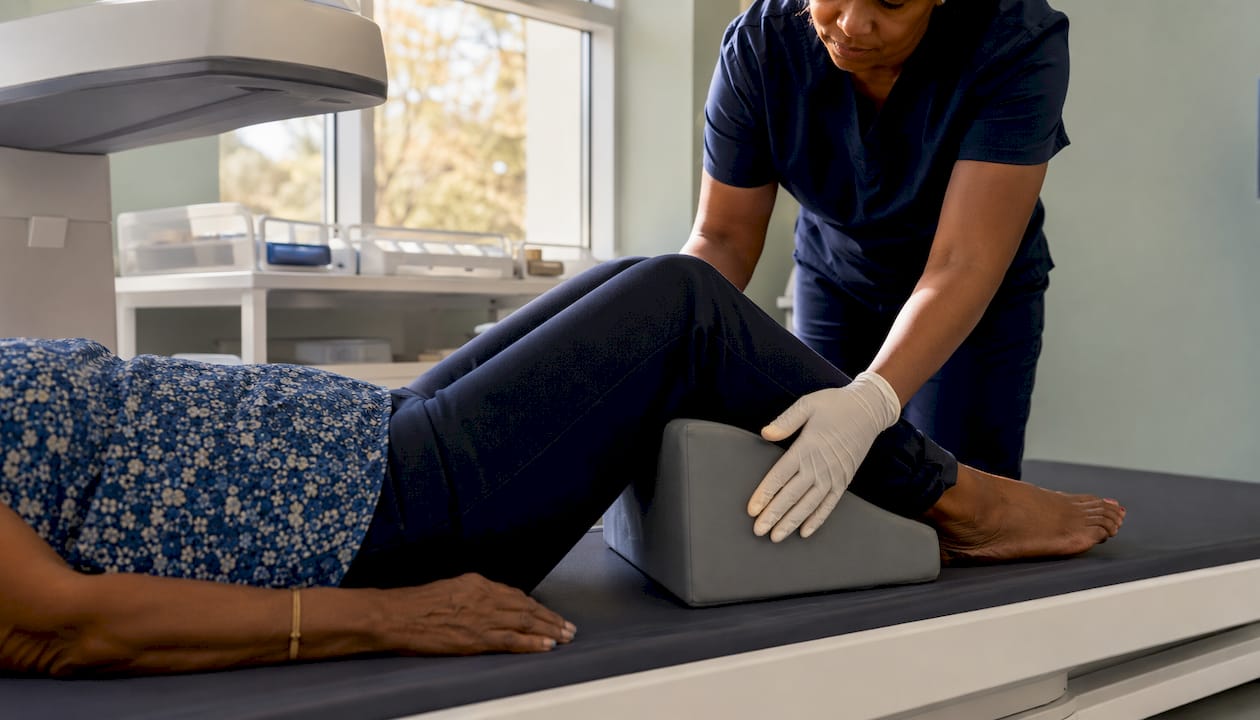
- A trained technologist positions your legs using a foam brace to align the hip correctly
- The scanner reads bone density at each site separately
- You can breathe normally throughout
Positioning matters more than most patients realism. The Ontario Association of Radiologists notes that accurate patient alignment is critical for producing reliable measurements, which is why trained technologists handle this step carefully.
Pro Tip: Arrive a few minutes early. Sinai Health advises that arriving ahead of your scheduled time allows the technologist to position you properly without rushing, which directly affects scan accuracy.
How to read your DXA scan results
Your results centre on the T-score, a number that tells you how your bone density compares to a healthy young adult at peak bone mass. The table below shows what each range means clinically.

| T-score range | Classification | What it means |
|---|---|---|
| Above -1 | Normal | Bone density is within a healthy range |
| -1 to -2.5 | Osteopenia | Lower than average; monitoring and lifestyle changes recommended |
| Below -2.5 | Osteoporosis | Significantly reduced density; treatment discussion warranted |
A radiologist interprets your scan and prepares a written report, typically available within a few days. Your referring physician then reviews the findings with you and decides on next steps.
Clinicians often use your T-score alongside tools like FRAX or CAROC to calculate your 10-year fracture risk. This combined picture is more useful than the T-score alone, since factors like age, weight, and smoking history all affect actual fracture probability. Your bone health trajectory over time matters as much as any single result.
Is a DXA scan safe?
Yes. The radiation dose from a DXA scan is very low, comparable to the exposure from a cross-country flight within Canada. For context, a standard chest X-ray delivers a meaningfully higher dose than a DXA scan. You can read more about X-ray safety if you want a broader comparison.
A few points worth knowing:
- DXA is not recommended during pregnancy; let your technologist know if there is any possibility you are pregnant
- No sedation or injection is involved
- You do not need to fast beforehand
- Metal objects and jewellery should be removed before the scan, as they can interfere with imaging
Many patients come in worried about radiation after hearing the word “X-ray.” Understanding the dose equivalency to a short flight tends to ease that concern quickly. The bone density test requires no special preparation beyond removing metal fasteners and jewellery.
How DXA differs from MRI, CT, and conventional X-rays
DXA uses two X-ray beams at different energy levels to isolate bone mineral from soft tissue. This dual-energy approach is what gives it accuracy that a standard X-ray cannot match. HealthLink BC explains that MRI uses magnetic fields rather than radiation, making it excellent for soft tissue detail but not suited for quantifying bone mineral density.
- Versus standard X-ray: A conventional X-ray can show a fracture but cannot reliably detect bone loss until density has dropped significantly. DXA catches changes far earlier.
- Versus CT scan: CT delivers a higher radiation dose and is not the preferred tool for routine osteoporosis screening.
- Versus MRI: MRI provides no bone density measurement. It is used for joint and soft tissue assessment, not osteoporosis diagnosis.
DXA remains the preferred modality for the hip and spine because peripheral tests, such as heel ultrasound devices, are less standardized and provide a limited picture of axial bone health.
What happens after your DXA scan results come in?
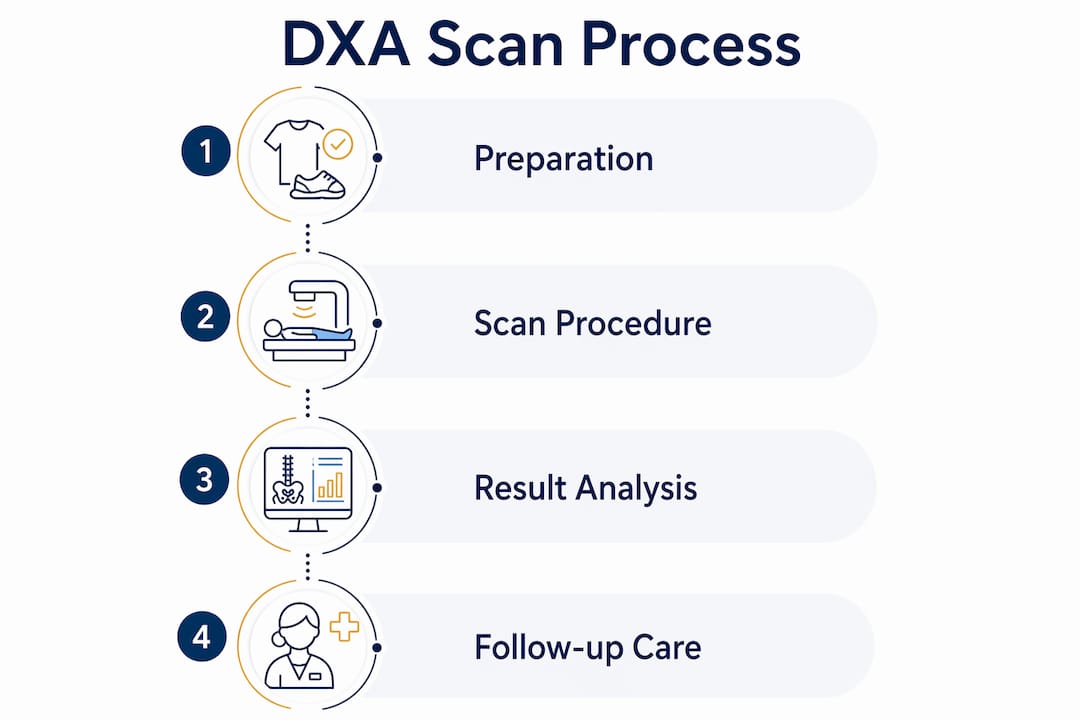
Your follow-up depends entirely on what your results show. If your T-score is normal, your physician may recommend a repeat scan in several years, or simply continue with preventive lifestyle guidance around calcium intake, vitamin D, and weight-bearing activity.
If results indicate osteopenia, your care plan typically focuses on lifestyle modification and monitoring. A repeat scan every one to two years is common for patients in this range, particularly if risk factors are present. Bone-strengthening programmes, such as those offered through OsteoStrong, can complement medical management by targeting skeletal loading.
For patients with a confirmed osteoporosis diagnosis, your physician will discuss medication options alongside lifestyle changes. DXA is also used to track whether treatment is working, with repeat scans scheduled periodically to measure any change in density. Research on complementary approaches, including vibration therapy and osteoporosis, continues to evolve and may be part of a broader conversation with your care team.
DXA scanning in Canada: what to expect from Cdncare
Access to bone density scanning in Canada varies by province, but referrals from a family physician or specialist are the standard pathway. In Ontario, many scans are covered under OHIP when medically indicated, meaning patients who meet screening criteria typically pay nothing out of pocket. Coverage for non-indicated scans or body composition assessments may differ; check with your provider before booking.
At Cdncare, the Canadian Diagnostic Network offers bone density scanning across more than 20 clinic locations in Ottawa, with over 150 radiologists and technologists on staff. Reports are typically ready within 24 to 48 hours, which means your physician can act on results quickly rather than waiting weeks.
- Bring your physician’s referral and health card to your appointment
- Wear comfortable, loose clothing without metal fasteners
- Arrive a few minutes early to allow time for proper positioning
- Ask the technologist any questions you have before the scan begins
Pro Tip: If you have had a previous DXA scan at another facility, bring those results with you. Comparing scans over time gives your care team a clearer picture of whether bone density is stable, improving, or declining.
Cdncare bone density scans: straightforward access, fast results
Getting a bone density scan through Cdncare means working with a team that has over 30 years of diagnostic imaging experience in Ottawa. The process is simple: your physician sends a referral, you book at one of the network’s clinic locations, and results reach your doctor within 24 to 48 hours. There is no lengthy wait for a specialist appointment, and no complicated preparation. If you are also interested in body composition beyond bone density, Cdncare offers body composition analysis using the same DXA technology. To find a location near you or book an appointment, visit the Cdncare locations page.
Key takeaways
A DXA scan is the most reliable non-invasive method for measuring bone mineral density and guiding osteoporosis care in Canada.
| Point | Details |
|---|---|
| What DXA measures | Bone mineral density at the hip and spine, plus body fat and muscle mass |
| Sensitivity | Can detect as little as 2% bone loss per year, enabling early diagnosis |
| T-score thresholds | Above -1 is normal; -1 to -2.5 is osteopenia; below -2.5 is osteoporosis |
| Safety profile | Radiation dose is comparable to a cross-country flight within Canada |
| Cdncare access | Bone density scans available across 20+ Ottawa locations, with results in 24–48 hours |
FAQ
What should you avoid before a DXA bone scan?
Avoid taking calcium supplements for at least 24 hours before your scan, and remove all metal jewellery and clothing fasteners before the procedure. No fasting is required.
Why would a doctor order a DXA scan?
A physician orders a DXA scan to diagnose osteopenia or osteoporosis, assess fracture risk, or monitor how well a patient is responding to bone-strengthening treatment. Osteoporosis Canada recommends routine screening for all adults aged 65 and older.
What is the difference between a DXA scan and an MRI?
DXA uses two low-energy X-ray beams to measure bone mineral density directly, while MRI uses magnetic fields to image soft tissue. MRI cannot quantify bone density, making DXA the preferred tool for osteoporosis diagnosis.
How long does a bone density scan take?
A DXA scan typically takes 15–20 minutes from start to finish. The procedure is painless, requires no sedation, and you remain fully clothed throughout.
Recommended
Your examination or doctor’s visit is 4 easy steps away