We now offer x-ray appointments at our Phenix, Charlotte, Rideau Valley, Nepean, Kanata, and Hunt Club clinics. Please check location availability before visiting.

Request an Appointment
Guide to preventative health screening for Canadian adults

TL;DR:
- Preventative health screening involves tests on asymptomatic individuals to detect diseases early. It is most effective when personalized based on age, family history, and lifestyle factors. Advances like AI imaging and multicancer blood tests are increasingly shaping future screening practices.
Preventative health screening is defined as a set of medical tests performed on people who have no symptoms, with the goal of detecting disease early when treatment is most effective. This guide to preventative health screening covers which tests matter, when to get them, and how to prepare, so you can make informed decisions rather than reactive ones. Early-stage cancer diagnosis has increased 5-year survival rates from 49% in the mid-1970s to 69% recently. That shift is almost entirely driven by catching disease before it causes symptoms. The same principle applies to heart disease, diabetes, and osteoporosis.
What does a guide to preventative health screening recommend by age?
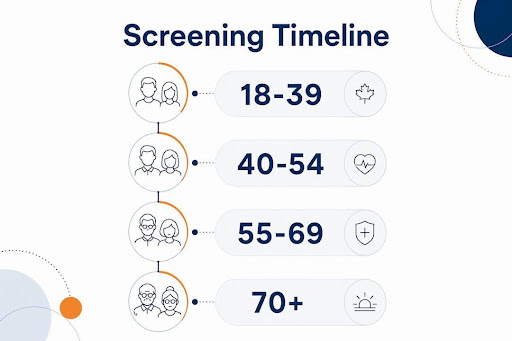
Screening recommendations are not one-size-fits-all. Your age, sex, family history, and lifestyle all shape which tests you need and how often. The table below outlines the core screenings for average-risk Canadian adults.

| Age group | Recommended screenings |
|---|---|
| 18-39 | Blood pressure every 2 years, Pap smear every 3 years (ages 21+), cholesterol check, diabetes risk assessment |
| 40-49 | Annual mammograms starting at 40, blood pressure annually if elevated, colorectal cancer discussion with your doctor |
| 50-64 | Colorectal cancer screening starting at 45, low-dose CT for lung cancer (if heavy smoker), bone density scan for women at menopause |
| 65+ | Annual blood pressure, bone density scan, vision and hearing checks, shingles vaccine, continued colorectal and breast screening |
Average-risk adults should begin colorectal cancer screening at age 45, get annual mammograms starting at 40, and have blood pressure checked every 2 years if readings are normal. If your blood pressure is elevated, annual monitoring is the standard. Cervical cancer screening follows a separate schedule: Pap smears every 3 years for ages 21-29, then an HPV and Pap combination every 5 years from ages 30-65.
Beyond cancer and cardiovascular checks, vaccination is a core part of preventative care. Vaccines prevent an estimated 4 million deaths globally each year. The seasonal flu vaccine is recommended annually for everyone over 6 months old, and your doctor can advise on boosters for tetanus, shingles, and pneumonia based on your age.
If you have a family history of breast or ovarian cancer, BRCA gene testing may be appropriate earlier than standard guidelines suggest. High-risk patients often begin mammography screening at 30 or even younger, and may require MRI alongside standard imaging.
How should you prepare for a preventative screening appointment?
A preventative care visit is not the same as a sick visit. You are not there because something is wrong. You are there to establish a baseline and catch anything that might be developing silently. Many chronic conditions develop without symptoms, and early detection enables less aggressive and more effective treatment.
Getting the most from your appointment takes a little preparation. Follow these steps before you go:
- Write down your family health history. Include first-degree relatives (parents, siblings, children) and any cancers, heart disease, or diabetes they were diagnosed with and at what age.
- List your current medications and supplements. Your doctor needs this to avoid duplicate testing and to flag interactions.
- Note any lifestyle factors. Smoking history, alcohol use, physical activity level, and diet all influence which screenings apply to you.
- Bring your vaccination records. Your provider can identify gaps and update your immunisations during the same visit.
- Prepare questions in advance. Ask specifically: "Which screenings do I need based on my history?" and "What would a positive result mean for me?"
Patients who prepare with detailed family history receive more personalised screening plans rather than generalised recommendations. That specificity matters. A woman with a first-degree relative diagnosed with breast cancer before age 50 may qualify for the Ontario Breast Screening Program at an earlier age than standard guidelines.
Pro Tip: Bring a written list of questions to your appointment. Doctors have limited time, and a written list ensures you cover everything without forgetting under pressure.
What are the benefits and limitations of common screening tests?
Screening saves lives. It also carries real risks that are worth understanding before you book. Screenings are only beneficial when the condition is common, detectable early, and treatable. Not every test meets all three criteria for every patient.
| Screening test | Key benefit | Key limitation |
|---|---|---|
| Mammography | Reduces breast cancer mortality effectively | Risk of false positives leading to unnecessary biopsies |
| Colonoscopy | Detects and removes polyps before they become cancer | Invasive; requires bowel preparation and sedation |
| Pap smear / HPV test | Detects cervical cell changes years before cancer develops | Can produce false positives causing patient anxiety |
| Low-dose CT (lung) | Detects early-stage lung cancer in high-risk smokers | High false-positive rate; radiation exposure |
| Blood pressure check | Non-invasive; identifies hypertension early | Requires consistent follow-up to be meaningful |
| Bone density scan | Identifies osteoporosis before fractures occur | Does not diagnose arthritis or other bone conditions |
False positives can lead to patient anxiety and unnecessary invasive follow-ups. This is not a reason to avoid screening. It is a reason to discuss the specific test's sensitivity and specificity with your doctor before you proceed. The U.S. Preventive Services Task Force (USPSTF) grades preventive services by strength of evidence, and those grades are a useful reference point when weighing your options.
Pairing screening with preventative wellness strategies such as regular movement and nutrition management reduces your overall disease risk and can lower the frequency of some monitoring tests over time.
Pro Tip: Ask your doctor whether a screening test has a Grade A or B recommendation from the USPSTF for your age and risk profile. That single question filters out low-value tests quickly.
What advances are changing preventative screening?
The next generation of screening is moving from population-level protocols toward individual risk profiles. Two developments are worth knowing about now.
- AI-enhanced imaging. Artificial intelligence tools are being integrated into mammography and radiology workflows to flag subtle findings that human readers might miss on a first pass. This does not replace the radiologist. It adds a second layer of review.
- Multicancer early detection (MCED) tests. These blood-based tests can screen for signals from multiple cancer types simultaneously. AI-enhanced detection and MCED tests are making screening more personalised and may improve survival outcomes significantly as they become more widely available.
- Risk-stratified screening intervals. Rather than fixed age-based schedules, emerging models use genetic data, lifestyle factors, and imaging results to recommend personalised intervals. A low-risk 55-year-old may not need annual screening, while a high-risk 38-year-old may need it sooner.
These tools are not yet standard across all Canadian clinics, but they are entering practice. Asking your provider whether any of these options apply to you is a reasonable and informed question.
Key takeaways
Preventative health screening is most effective when it is personalised, consistent, and balanced against the real risks of overtesting.
| Point | Details |
|---|---|
| Start screening early | Colorectal screening begins at 45; mammograms at 40 for average-risk adults. |
| Personalise your plan | Family history and lifestyle determine which tests apply to you specifically. |
| Understand test limits | False positives are common; discuss sensitivity and USPSTF grades with your doctor. |
| Vaccination counts | Immunisations are a core part of preventative care, not a separate concern. |
| New technology is coming | MCED tests and AI imaging are entering practice and will reshape screening intervals. |
Screening is not a passive act
I have spoken with many patients who treat their annual physical as a formality. They show up, answer a few questions, and leave without asking a single thing. That approach misses the point entirely.
Screening is a gateway to whole-person care. The appointment is your chance to surface a family history your doctor does not know about, flag a symptom you have been dismissing, or ask whether your current screening schedule still fits your life. Preventative health visits often include counselling on health behaviours, which means the conversation about your diet, sleep, and stress levels belongs there too.
The patients I see who get the most value from screening are the ones who come prepared and treat it as a two-way conversation. They leave with a specific plan, not just a clean bill of health. That is the difference between screening as a checkbox and screening as genuine health management.
How Cdncare supports your screening needs
Cdncare operates across more than 20 clinic locations in Ottawa and is one of the largest providers in the Ontario Breast Screening Program network. Services include mammography, ultrasound, X-ray, bone density scanning, and vascular imaging, with results typically available within 24-48 hours. Walk-in imaging is available at urgent care imaging locations for patients who need timely access without a long wait. Whether you are following up on a screening result or booking a baseline scan, Cdncare's team of over 150 radiologists and technologists is equipped to support your next step.
FAQ
What is preventative health screening?
Preventative health screening is a set of medical tests performed on people without symptoms to detect disease early. The goal is to identify conditions when they are most treatable, before they cause noticeable problems.
How often should adults get screened?
Preventive care visits are recommended every 3-5 years for adults aged 18-39 and annually for those over 40. Specific tests like blood pressure checks and mammograms have their own intervals based on your results and risk level.
What is the difference between a preventative visit and a sick visit?
A preventative visit focuses on asymptomatic patients and includes screenings, immunisations, and health counselling. A sick visit addresses an existing symptom or condition. They are billed and structured differently.
Can screening cause harm?
Yes. Screening tests carry risks including false positives, overdiagnosis, and anxiety from unnecessary follow-up procedures. Discussing the evidence grade for any test with your doctor helps you weigh benefits against potential harms.
Does family history change my screening schedule?
Family history is one of the strongest factors in personalising your screening plan. A first-degree relative with breast, colorectal, or ovarian cancer typically moves your recommended start age earlier and may add tests like genetic screening or MRI.
Recommended
- CDN Ottawa's Premier X-Ray, Ultrasound, Mammogram, Imaging Clinic Centres | CDNcare.ca
- Experts urge routine mammograms, cancer screenings after COVID-19 | Canadian Diagnostic Network
- Should I Get a Mammogram at 35?
- OBSP - Ontario Breast Screening Program | Canadian Diagnostic Network
Your examination or doctor’s visit is 4 easy steps away