We now offer x-ray appointments at our Phenix, Charlotte, Rideau Valley, Nepean, Kanata, and Hunt Club clinics. Please check location availability before visiting.

Request an Appointment
Guide to x-ray referrals: what patients and clinicians need to know

TL;DR:
- An x-ray referral is a clinical request issued by a healthcare professional to authorize diagnostic imaging for a specific concern.
- Clear, focused referrals with the clinical question and red flags improve imaging speed and diagnostic accuracy.
An x-ray referral is a formal clinical request, issued by a qualified healthcare professional, authorising diagnostic imaging for a specific medical concern. This guide to x-ray referrals covers everything from what belongs in a well-written referral to how you book your appointment and what happens when your case is urgent. In Canada, the referral process is the gateway to publicly funded diagnostic imaging. Understanding it reduces delays, improves results, and helps both patients and clinicians get the most from every scan.
What does a guide to x-ray referrals cover?
An x-ray referral, also called a diagnostic imaging request, is not simply a permission slip to scan a body part. It is a clinical communication tool. The referral tells the radiologist what question needs answering, which directly shapes how the imaging is performed and interpreted. Referral letters are often the radiologist's only source of clinical context when primary medical notes are unavailable. That makes the quality of the referral inseparable from the quality of the result.

In Canada, x-ray referrals are issued by physicians, nurse practitioners, and specialists. They are required for all publicly funded imaging. The Canadian healthcare system uses referral information to triage appointments, allocate resources, and protect patients from unnecessary radiation exposure. Knowing how the process works helps you prepare, ask the right questions, and avoid common delays.
What information must an effective x-ray referral include?
A well-written referral focuses on the clinical question, not on specifying imaging views. Stating the clinical question clearly, such as "query meniscal tear, left knee, following twisting injury," gives the radiologist the context needed to select the right protocol. Prescribing specific views instead is one of the most common clinician errors, and it limits the radiologist's ability to tailor the study.
The referral should be a concise paragraph that includes:
- Injury mechanism: How did the problem start? A fall, a twisting motion, a gradual onset?
- Symptom location: Left or right side, specific anatomical region.
- Symptom duration: Days, weeks, or months of symptoms.
- Red flags: Night pain, unexplained weight loss, fever, or neurological changes.
- Relevant history: Prior surgeries, known conditions, or previous imaging results.
Effective referrals include all of these elements in plain, specific language. Vague referrals like "knee pain, please x-ray" give the radiologist almost nothing to work with. The result is a scan that may miss the clinical point entirely.
Pro Tip: Avoid copying an entire medical history into the referral. Include only what is directly relevant to the imaging question. A focused, two-to-three sentence referral is almost always more useful than a lengthy summary.
How do patients obtain and use x-ray referrals in Canada?
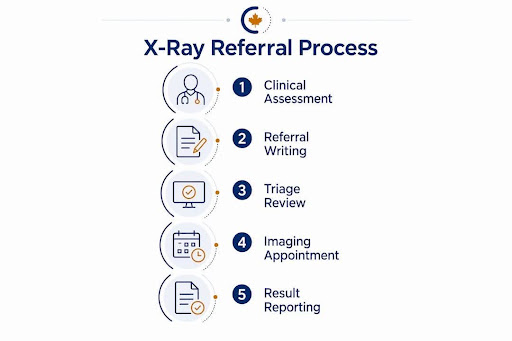
The x-ray referral process for patients follows a clear sequence. Understanding each step reduces anxiety and prevents avoidable delays.
- Receive your referral. Your physician, nurse practitioner, or specialist assesses your symptoms and issues a written or electronic referral.
- Choose your imaging provider. You are not required to attend the specific clinic named on the referral. Referrals are valid at any qualified imaging provider offering the required service.
- Book your appointment. Contact the imaging centre directly. Bring your referral, your health card, and any relevant prior imaging.
- Attend your appointment. A registered technologist performs the x-ray. Results are sent to your referring clinician, typically within 24-48 hours at facilities like Cdncare.
- Follow up with your clinician. Your referring provider reviews the radiologist's report and discusses next steps with you.
Wait times for diagnostic imaging vary widely. Urgent cases may be seen within days. Routine, non-urgent referrals can involve waits of several weeks to months, depending on your location and the imaging centre's capacity. Patients who need faster access can ask their clinician to mark the referral urgent if clinical criteria support it, or explore privately funded imaging options where a clinician still provides oversight.
Pro Tip: Ask your clinician whether your referral is open to any imaging provider. Many patients assume they must attend a specific location, which can mean longer waits when a closer or faster option is available.
How are urgent and routine referrals triaged?
Referral urgency is determined by clinical information, not by patient preference. Referrals marked urgent due to red flags such as night pain, unexplained weight loss, or suspected malignancy receive priority scheduling. This distinction is not administrative. It reflects the clinical risk of delayed diagnosis.
A referral that clearly documents red flags is more likely to be triaged appropriately. Clinicians who omit urgency markers risk their patients waiting weeks for imaging that should happen within days.
Triage in the Canadian system works through a combination of imaging centre staff review and, in some regions, digital referral hubs that manage demand across multiple providers. These hubs use national triage criteria to match referral urgency with available appointment slots. The practical effect is that a well-documented urgent referral moves faster through the system than one that buries the red flags in general history.
Common misconceptions about urgency include the belief that all x-rays are scheduled equally, or that showing up at an imaging centre without a referral will result in faster care. Neither is accurate. Walk-in x-ray services do exist, but they still require a valid referral from a qualified clinician.
What are the most common mistakes in the x-ray referral process?
Both patients and clinicians make predictable errors that slow down imaging or reduce its diagnostic value. Recognising these mistakes is the first step to avoiding them.
Common patient misconceptions:
- Believing you can self-refer for publicly funded imaging. Self-referral is not available in the public system. A clinical assessment is always required.
- Assuming the referral locks you into one imaging provider. You can usually take your referral to any qualified centre.
- Thinking a longer wait means your case is not serious. Wait time reflects system capacity, not clinical priority.
Common clinician errors:
- Specifying x-ray views rather than posing the clinical question. Radiologists select protocols based on clinical context, not prescribed views.
- Including excessive, irrelevant medical history that obscures the key question.
- Failing to mark urgent referrals clearly, which delays triage.
Pro Tip: Frame the referral around what you need to know, not what you want to see. "Rule out fracture following fall, right wrist, acute onset" is far more useful than "right wrist x-ray, AP and lateral views."
Key takeaways
A clear, focused referral with documented red flags and a specific clinical question is the single most effective way to improve both the speed and quality of diagnostic imaging.
| Point | Details |
|---|---|
| Referral is a clinical tool | It communicates the imaging question, not just a body part to scan. |
| Include the right details | Mechanism, location, duration, red flags, and relevant history are all required. |
| You can choose your provider | A valid referral works at any qualified imaging centre offering the required service. |
| Urgency must be stated clearly | Red flags must be documented explicitly for the referral to be triaged as urgent. |
| Self-referral is not available publicly | All publicly funded imaging requires a referral from a qualified healthcare professional. |
What I have learned from watching referrals shape outcomes
After years of working alongside radiologists and seeing how referrals arrive at imaging centres, one pattern stands out clearly. The referrals that lead to the most useful reports are almost never the longest ones. They are the most specific ones.
A clinician who writes "left knee pain, query meniscal tear, onset after soccer injury three weeks ago, night pain present" gives the radiologist a complete picture in one sentence. A referral that runs three paragraphs of general medical history, without naming the clinical question, often produces a report that hedges and qualifies rather than answers.
Patients feel this difference too, even if they cannot name it. When a referral is clear, the appointment runs smoothly, the technologist knows what to focus on, and the report comes back with a direct answer. When it is vague, patients sometimes find themselves called back for additional imaging, which adds anxiety and delay.
My honest advice to clinicians: treat the referral as a consultation note to a colleague, not a form to fill out. And to patients: if you are unsure whether your referral is open to multiple providers, ask before you book. That one question can save you weeks.
X-ray imaging at Cdncare: walk-in and urgent options
Cdncare operates across more than 20 locations in Ottawa, with dedicated urgent care imaging services for patients who need x-rays quickly. You can bring an existing referral from any qualified clinician and book directly at a Cdncare facility. Results are typically available within 24-48 hours, sent directly to your referring provider. For patients who are unsure whether they need an x-ray, Cdncare's referral guidance helps clarify when imaging is appropriate. With over 30 years of experience and a team of more than 150 radiologists and technologists, Cdncare is built to support both routine and time-sensitive imaging needs.
FAQ
Do I need a referral to get an x-ray in Canada?
Yes. Publicly funded x-ray imaging in Canada requires a referral from a physician, nurse practitioner, or specialist. Private imaging options exist but still involve clinical oversight.
Can I use my referral at any imaging centre?
In most cases, yes. Referrals are valid at any qualified imaging provider offering the required service, not only the one named on the form.
How long will I wait for an x-ray appointment?
Wait times vary from a few days for urgent cases to several weeks or months for routine referrals, depending on location and imaging centre capacity.
What should a clinician include in an x-ray referral?
The referral should state the clinical question, injury mechanism, symptom location and duration, any red flags, and relevant medical history in concise, specific language.
What happens if my referral is marked urgent?
Urgent referrals are prioritised in scheduling based on documented red flags such as night pain or suspected malignancy. Clear documentation of urgency is what triggers faster triage.
Recommended
- How to Tell If You Need an X-Ray | Canadian Diagnostic Network
- How Many X-Rays Are Safe in a Lifetime?
- Our Specialists | Canadian Diagnostic Network
- X-Ray | Canadian Diagnostic Network
Your examination or doctor’s visit is 4 easy steps away